A history of the Lenormand cards
The cards called 'Lenormand' were not made by Mademoiselle Lenormand. They come from a German board game of 1799 and took her name after her death.[6][8][7]
- 1799
The Game of Hope
Johann Kaspar Hechtel (1771–1799), a Nuremberg businessman and game designer, created Das Spiel der Hoffnung: 36 picture cards published by G. P. J. Bieling, each with a playing card inset. Players laid the cards in a 6×6 grid and moved by dice. The first to land on card 35, the Anchor (hope), won; card 36, the Cross, trapped a player. The rules sheet also gave layouts for fortune-telling. [6][2][10]
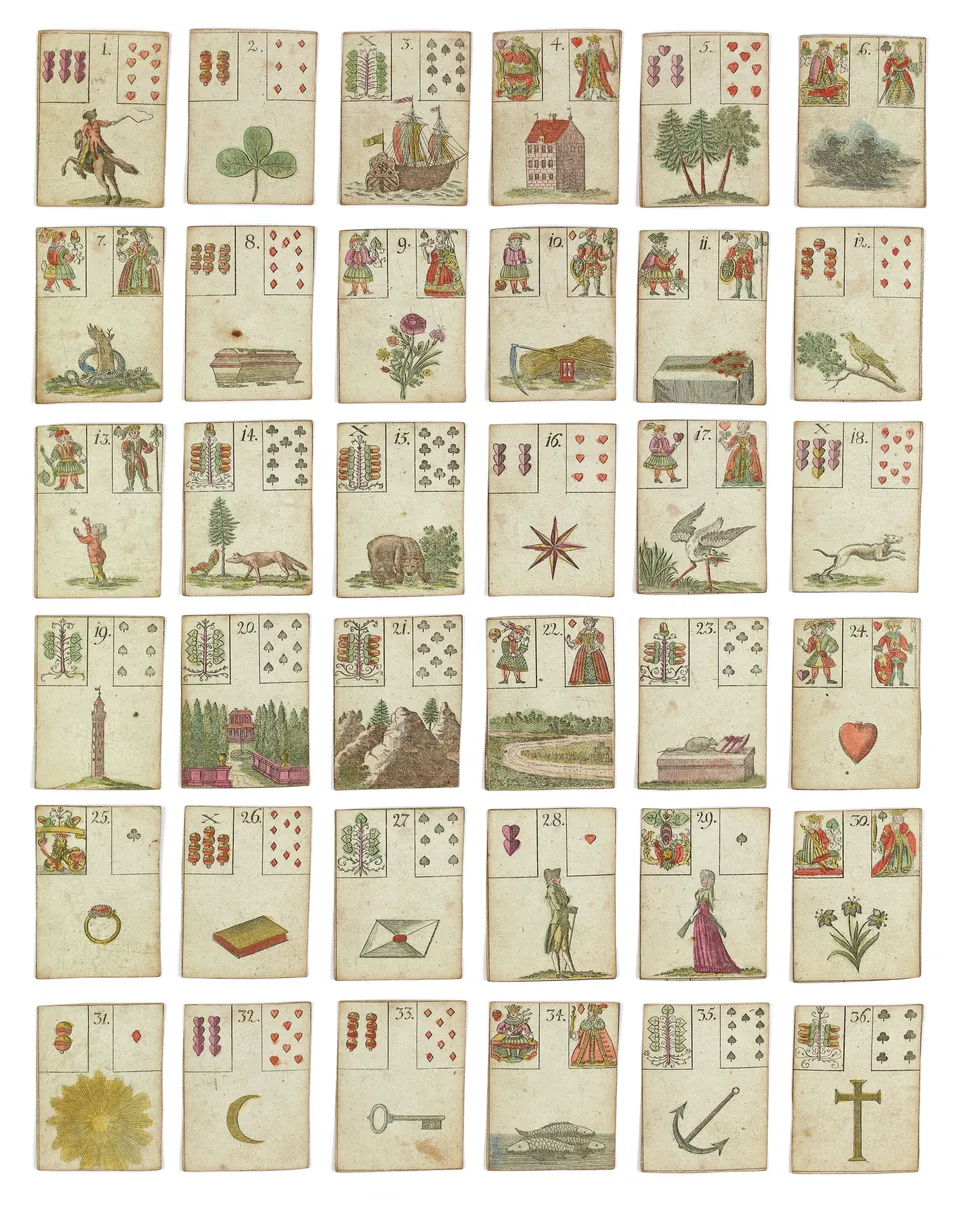
The 36 cards of the Game of Hope, 1799 - 1772–1843
Mademoiselle Lenormand
Marie Anne Adélaïde Lenormand, born in Alençon on 27 May 1772 and died in Paris on 25 June 1843, was the most famous fortune-teller of the Revolution and the Napoleonic Empire. She was arrested several times (for example 1793–1794 and 1803). She read tarot and ordinary cards, coffee grounds and palms. There is no evidence that she designed or used the 36-card deck later sold under her name. [5][7][8]
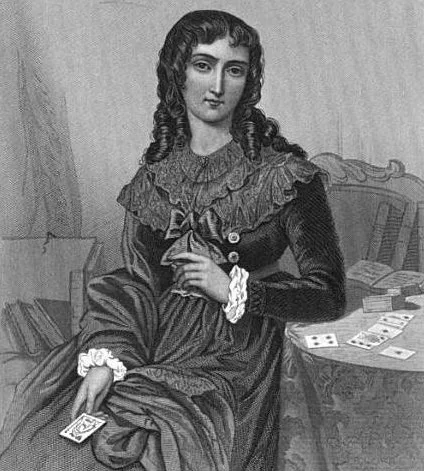
Engraving of Mlle Lenormand (1858) - 1845–1850s
- 1850–1900
The parlour era
Chromolithography made colourful cards cheap, and the Petit Lenormand spread through Germany, Central Europe, France and Belgium. Many publishers printed the meaning on the card itself, like the Bruges deck used on this site, whose texts read each card by its distance from the querent's card. [1][7]
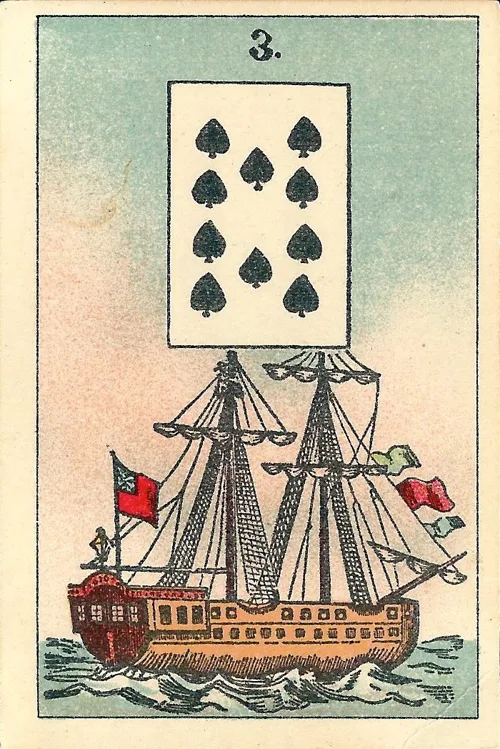
German Lenormand card, c. 1890 - 1972
- Today
Today
Lenormand is still widely read in France, the Low Countries, Central Europe, the Balkans, Russia and Brazil, and has had a worldwide revival since around 2010, with many contemporary decks that keep the same order and core images. [7]