How to read Lenormand
Core principles
Read cards as a sentence
Each card has a plain meaning, like a word. Cards placed together modify each other like a noun and an adjective, so the meaning comes from the combination, not from single cards. [11][14]
Near and far
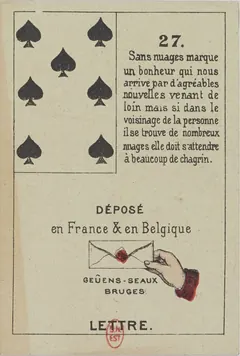
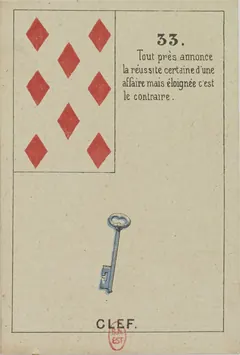
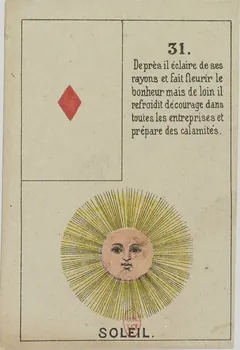
The oldest rule, printed on the 19th-century cards themselves: cards near the querent's card act strongly; cards far away weaken or, for some cards, reverse. A distant Sun, for example, 'chills'. [1]
The influence of the Clouds
Several traditional card texts (2, 16, 18, 19, 22, 27, 30) change meaning when the card is 'surrounded by clouds', which makes the Clouds the deck's most important modifier. [1]
The original instructions (c. 1895–1901)
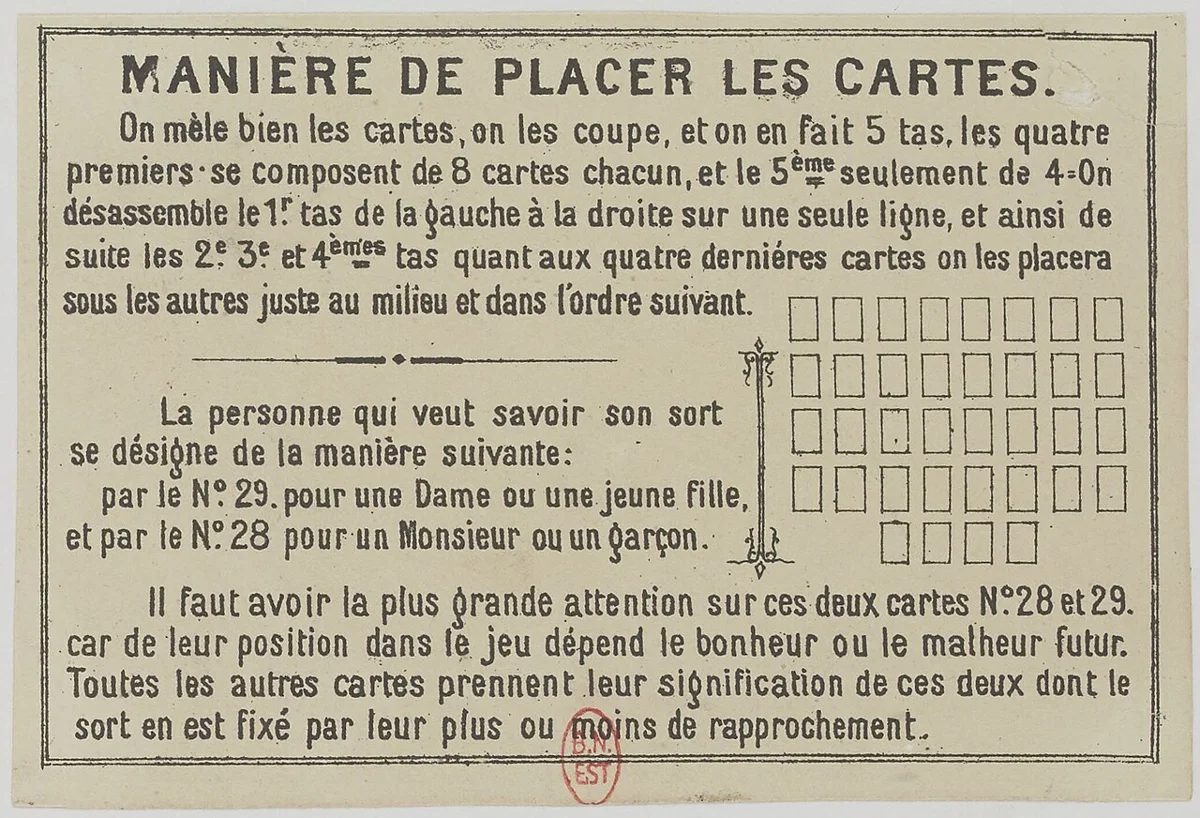
Shuffle the cards well, cut them, and make 5 piles: the first four of 8 cards each, the fifth of only 4. Lay out the first pile from left to right in a single row, and the same with the 2nd, 3rd and 4th piles; the last four cards go beneath the others, exactly in the middle, in the order shown.
The person who wishes to know their fate is represented as follows: by No. 29 for a lady or a girl, and by No. 28 for a gentleman or a boy.
Pay the greatest attention to these two cards, Nos. 28 and 29, for future happiness or misfortune depends on their position in the spread. All the other cards take their meaning from these two, their fate being fixed by how near or far they lie.
Original French
On mêle bien les cartes, on les coupe, et on en fait 5 tas ; les quatre premiers se composent de 8 cartes chacun, et le 5ème seulement de 4. On désassemble le 1er tas de la gauche à la droite sur une seule ligne, et ainsi de suite les 2e, 3e et 4èmes tas ; quant aux quatre dernières cartes on les placera sous les autres juste au milieu et dans l'ordre suivant.
La personne qui veut savoir son sort se désigne de la manière suivante : par le N° 29 pour une Dame ou une jeune fille, et par le N° 28 pour un Monsieur ou un garçon.
Il faut avoir la plus grande attention sur ces deux cartes N° 28 et 29, car de leur position dans le jeu dépend le bonheur ou le malheur futur. Toutes les autres cartes prennent leur signification de ces deux dont le sort en est fixé par leur plus ou moins de rapprochement.
Spreads
Knighting
From the significator, move in an L-shape like a chess knight. The cards reached (up to eight) often reveal hidden influences. [16]